


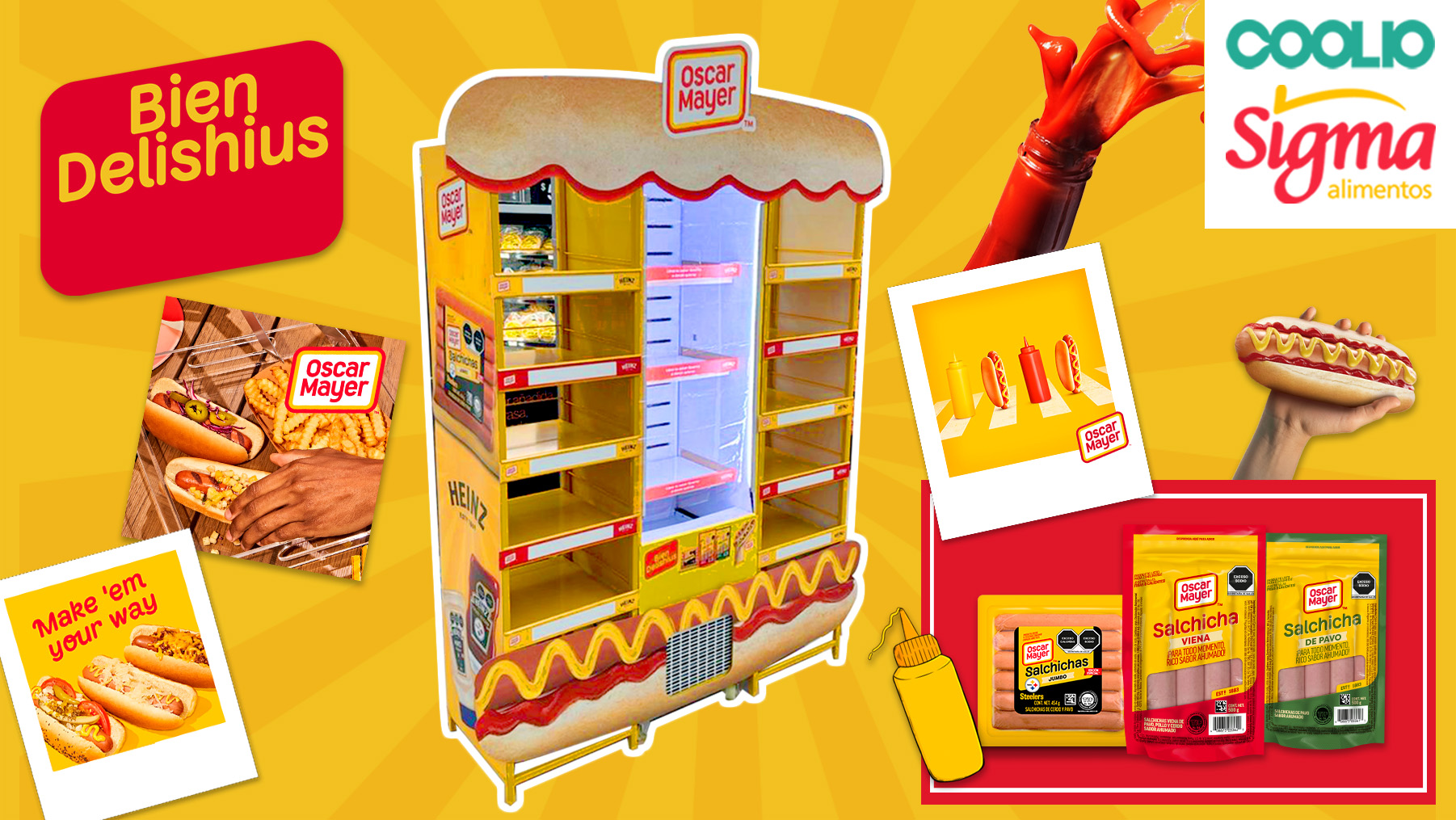

We are a global company dedicated to providing communities' favorite foods. With a presence in 18 countries, we offer quality products across a variety of categories and price points.
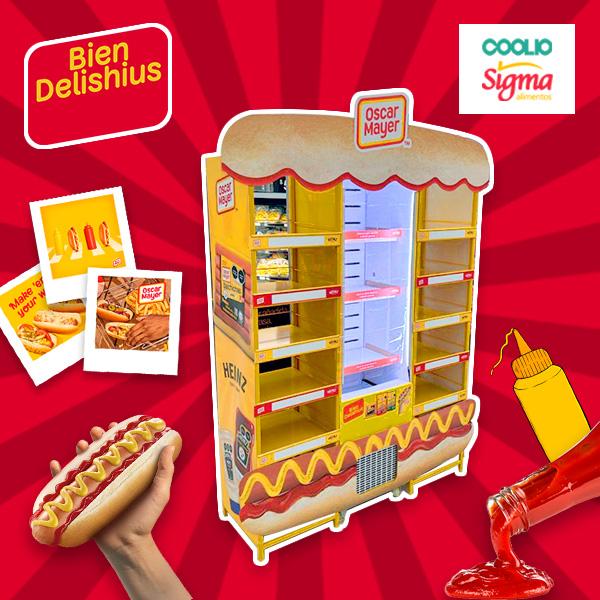
In today’s retail environment, the point of sale is no longer a passive shelf. It has evolved into a highly competitive visual battlefield where brands are not only fighting for space, but for attention, comprehension, and—most importantly—spontaneous preference.
Within this landscape, Oscar Mayer faced a challenge that is both common and increasingly urgent: how to ensure that its products stand out in front of the shopper without relying exclusively on the conventional refrigerated aisle of the supermarket.
The issue was twofold.
On one hand, there was the visual saturation of refrigerated aisles, where dozens of brands compete for mere seconds of attention within a dense, repetitive environment. The traditional refrigerator, while functional, had become a limiting factor—flattening brand differentiation and forcing products into a homogeneous visual grid.
On the other hand, there was a deeper behavioral shift: the fragmentation of the shopper journey. Consumers no longer move through stores in predictable, linear paths. Their decisions are increasingly intuitive, emotional, and influenced by stimuli encountered outside of traditional category boundaries.
In this context, Oscar Mayer needed a solution capable of addressing multiple strategic objectives simultaneously:
The challenge was not simply to stand out.
It was to break away from the structural limitations of the category itself.
The response was the development of a hybrid Coolios Island—a three-dimensional retail solution that integrates portable refrigeration, metal display structures, and immersive branding into a single cohesive system.
Rather than designing a conventional display, the objective was to create a piece of mobile commercial architecture capable of translating the Oscar Mayer universe into the visual language of modern retail.
At the heart of the island lies a Coolio Checkout model, a cube-shaped refrigerated unit enclosed within a Freshboard structure made of printed corrugated cardboard.
This central module includes:
This design achieves a critical balance: products remain cold, yet fully visible and easily reachable by the shopper.
The refrigeration is no longer hidden infrastructure.
It becomes part of the visual experience.
Flanking the central Coolio unit are two metal display structures, each featuring four levels of shelving for non-refrigerated products.
These lateral modules introduce a key strategic advantage: cross-category integration.
They allow for the inclusion of complementary products such as:
This duality—refrigerated core and ambient side displays—transforms the island into a complete consumption system, rather than a single-category solution.
The shopper is no longer required to search across the store.
Everything is presented within one cohesive environment.
To ensure structural and visual cohesion, the system incorporates two key graphic elements:
These components connect the three modules into a single visual block.
The graphic treatment is particularly significant: it simulates the shape and texture of a hot dog bun at a large scale, effectively framing the entire island within a recognizable and emotionally charged visual cue.
This decision transforms the display into something more than a branded fixture.
It becomes iconography.
From any angle, the shopper immediately understands the context—not through explanation, but through visual association.
The full island measures:
These dimensions were carefully calibrated to achieve a balance between presence and integration.
Additionally, the modular system is designed for tool-free assembly and disassembly, allowing store teams to install, reposition, or remove the island with minimal effort.
Mobility becomes a strategic asset.
The combination of materials is deliberate and multidimensional:
This hybrid approach results in a solution that is:
The island is not only functional—it is aligned with evolving retail standards around sustainability and operational simplicity.
The Coolios Island delivered a retail solution that extended far beyond traditional merchandising.
It did not simply display products.
It redefined how they are perceived, discovered, and purchased.
The graphic coherence between header, banner, and side elements created a compact, highly recognizable visual block.
Within seconds, shoppers identified the brand.
The hot dog-inspired design acted as an immediate emotional trigger—evoking taste, familiarity, and appetite without requiring textual explanation.
Oscar Mayer became memorable in less than three seconds.
The vertical organization of products, combined with internal lighting and lateral product integration, generated a sense of abundance and clarity.
Shoppers did not pass by.
They stopped, explored, compared.
This increased dwell time directly enhanced both purchase probability and overall perception of the brand.
By consolidating refrigerated and complementary products within a single ecosystem, the island enabled natural cross-selling behavior.
Shoppers could assemble a complete purchase—proteins, condiments, and accompaniments—without leaving the display.
This eliminated friction and increased basket size organically.
The modular design and recyclable materials allowed for:
Additionally, the use of autonomous refrigeration reduced dependence on energy-intensive infrastructure.
Perhaps the most significant outcome was strategic.
Oscar Mayer did not simply gain visibility.
It redefined its presence within the category.
Instead of competing within the refrigerated aisle, the brand created its own controlled environment—a space where it dictated visual language, product organization, and shopper interaction.
It moved from being one option among many
to becoming a complete, self-contained retail universe.
The Coolios Island for Oscar Mayer illustrates a broader shift in retail strategy.
Visibility alone is no longer sufficient.
Brands must create systems that integrate product, narrative, and behavior into a single experience.
A refrigerated core.
Two lateral expansion modules.
A unified graphic identity.
A compact yet dominant footprint.
A structure designed for mobility, sustainability, and impact.
This is not a display.
It is an ecosystem.
And in a retail environment defined by fragmentation and limited attention, the brands that succeed will not be those that occupy more space but those that use space more intelligently.
Know more about our store display.


Rodrigo de Triana 2928
Col. Vallarta Norte CP 44690
Guadajalara, JAL, México.

+52 (33) 3810-1077
10052 Monroe Dr.
75229-5703. Dallas,
TX, USA.

.png)