

You are not the only one. And it is not an accident.

Why do we put things in the cart that we never planned to buy? We explore the psychological mechanisms behind impulse purchasing and how well-designed displays activate them strategically at the point of sale.
You left home with a list. Cheese, milk, bread, detergent. Four things. You walk into the supermarket fully intending to buy exactly that and nothing else. Forty minutes later you're at the register with sixteen products in the cart and a vague feeling that something did not go according to plan.
You're not the only one. And it's not an accident.
What happens between the supermarket entrance and the checkout line is one of the most studied phenomena in consumer psychology: impulse buying. And behind every product that slips into the cart without having been on the list, there is a series of precise psychological mechanisms, deliberately activated by the design of the shopping environment.
Understanding those mechanisms is not just fascinating. For any brand competing at the point of sale, it is strategically indispensable.
The academic definition is clear: an impulse purchase occurs when the consumer makes an unplanned, immediate buying decision without prolonged reflection, motivated primarily by an external stimulus in the shopping environment.
What that definition does not say is that impulse buying is not a shopper's mistake or a character flaw. It is a perfectly rational response from the human brain to certain stimuli. The brain does not process every decision with the same level of analysis — it couldn't, it would be exhausting. For low-risk, low-cost decisions, the brain activates cognitive shortcuts that allow fast, low-effort decision-making.
Well-designed displays speak exactly the language of those shortcuts.
The human brain has a documented tendency to overestimate the importance or value of whatever is most present in its mind at a given moment. In the point-of-sale context, this translates into something very concrete: the product the shopper sees first, most clearly and most easily has an enormous advantage over the one they have to go looking for.
A display placed outside the linear refrigerator, in the main aisle or in a high-traffic zone, activates this bias directly. The product is not competing for attention inside a saturated space — it is alone, visible, available. The brain registers it easily and processes it as a relevant option without additional effort.
For refrigerated products, this has a direct implication: as long as they remain confined to the linear refrigerator, they compete in an environment where the availability bias works against them. Every product is equally visible — or equally invisible.
When a person enters a supermarket, their brain enters a particular state that consumer psychologists call "exploration mode." The rational guard drops. Attention becomes peripheral and receptive. The shopper is not processing information critically — they are navigating, absorbing stimuli almost passively.
This state is the most fertile possible ground for impulse buying. And it lasts exactly as long as the shopper is moving through the store.
A well-placed display in the aisle interrupts that flow in a positive way — not irritating, but surprising. The shopper did not expect to find that product there. That novelty activates additional attention automatically. And additional attention is the first step toward purchase.
The human brain is wired to respond to scarcity. It is an evolutionary mechanism: limited resources must be taken advantage of when available because they might not be there tomorrow. In the context of modern consumption, this instinct is activated by stimuli far subtler than a food shortage.
A temporary display — by its very nature — communicates scarcity. It is not there all the time. It is an activation, a promotion, a limited presence. The shopper who sees it knows, consciously or not, that this opportunity might not be there on their next visit.
This activates situational urgency: the feeling that deciding now is better than deciding later. And situational urgency is one of the most powerful triggers of impulse buying, especially for products with a relatively low price where the risk of regret is minimal.
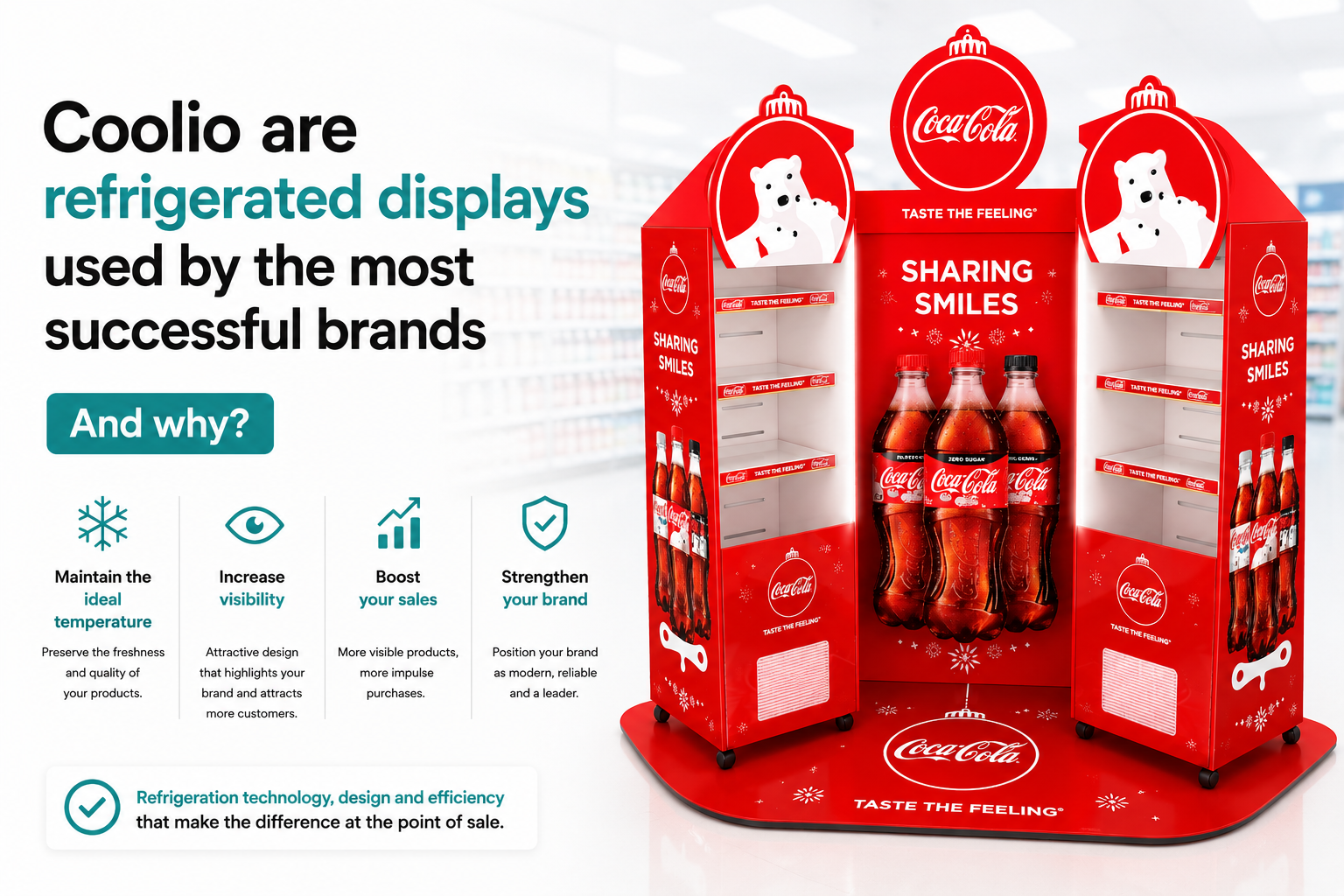
The Coolio Freshboard, being a temporary and deployable display tool, carries this advantage built in. Its presence in the aisle communicates opportunity — and opportunities get taken.
Human beings are deeply social. One of the fastest ways the brain evaluates whether something is good is by observing whether other people are also choosing it. At the point of sale, this translates into a very concrete phenomenon: a full, well-organized display communicates popularity, while an empty or neglected one communicates the opposite.
But there is something more powerful than a full display: the display that visually appears to be being actively chosen. A Coolio placed in a high-traffic zone, with well-presented product and open access, generates the perception that it is an active point of interest in the store. Other shoppers who walk past and see someone picking a product from the display receive an implicit social signal: something interesting is happening there.
This is the principle behind why the smartest brands do not just worry about placing the display — they focus on keeping it stocked and visually active throughout the entire activation.
There is a principle in behavioral psychology that states that the ease of executing an action directly predicts the likelihood that the action will occur. Put more simply: the easier it is to pick up the product, the more likely the shopper is to pick it up.
Refrigerated products in the linear unit have built-in friction: a door must be opened, rows must be searched through, sometimes bending or stretching is required, the product must be identified among similar ones. Each of those steps is a micro-barrier that increases the probability that the brain decides it is not worth the effort.
The Coolio Open Top and the Coolio Dumpbin eliminate all of that friction. The product is in sight, within reach, with no physical barriers between the shopper and the product. The decision is reduced to its simplest form: see it and take it.
In consumer psychology terms, that is behavioral design applied to the point of sale. And it works.
Everything above converges on a central idea that the most sophisticated trade marketing brands have already internalized: the display is not a piece of furniture. It is a decision architecture.
Every design element — the height of the display, the position of the product, the photography, the color, the lighting, the text, the physical access — communicates something to the shopper's brain and guides their decision in a direction. Not in a manipulative way, but in the same way that the design of any human environment guides behavior: by making certain actions easier, more natural, and more attractive than others.
The Coolio Freshboard is designed with this logic built into its structure:
Complete visual customization activates brand recognition and trust, reducing the cognitive effort needed to decide. Optional LED lighting creates visual contrast in the aisle and automatically directs attention toward the display. Open access in the Open Top and Dumpbin models eliminates physical friction and makes picking up the product the path of least resistance. Placement outside the linear refrigerator creates novelty and activates the flow effect described above. And the temporary format generates the situational urgency that pushes the decision from later to right now.
None of these elements is accidental. All of them respond to documented, measurable psychological mechanisms.
If your product is refrigerated and currently only exists inside the linear unit, you are competing with your hands tied from a psychological standpoint. Not because your product is inferior. But because the environment it is placed in deactivates most of the mechanisms that generate impulse buying.
The question is not whether the psychology of the impulse buyer can work in your product's favor. It can. The question is whether you are giving it the conditions for that to happen.
A Coolio well placed in the right aisle, at the right moment in the activation, with the right brand design, is not a trade marketing expense. It is an investment in psychology applied to the point of sale. And the results — up to a 500% increase in sales according to POPAI data — are the evidence that the shopper's brain responds exactly as the science predicts.
The impulse buyer does not need convincing. They just need you to set the right conditions.
Learn more about our refrigerated displays at cooliodisplay.com
Learn more about our refrigerated display.


Rodrigo de Triana 2928
Col. Vallarta Norte CP 44690
Guadajalara, JAL, México.

+52 (33) 3810-1077
10052 Monroe Dr.
75229-5703. Dallas,
TX, USA.