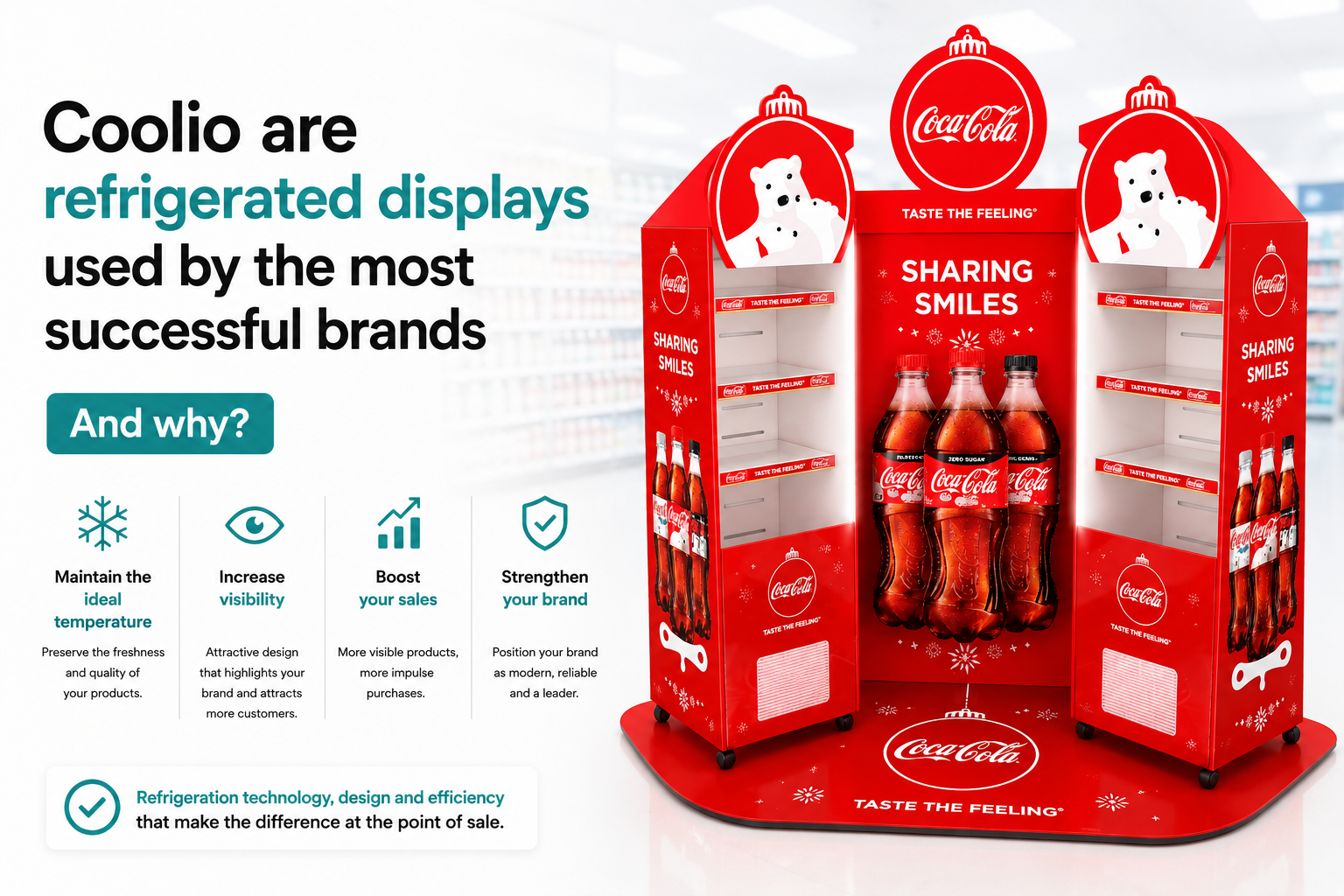


Growth hackers know that competing in the arena where everyone else plays is the most expensive and least efficient strategy.

Most brands that want to sell more in the supermarket do the same things: reformulate the product, redesign the packaging, increase the media budget, or cut the price. Months of work, considerable investment, uncertain results.
There is a lever that almost nobody is using. And it has nothing to do with the product.
It has to do with where the product is, when it appears, and how it looks when the shopper walks past it. In other words: it has to do with display strategy. And in the world of refrigerated products, that lever is called the Coolio Freshboard.
This is not a story about branding or advertising. It is a story about growth hacking applied to retail — the discipline of finding the point of least resistance where a small intervention produces a disproportionate result.
There is an uncomfortable truth in the world of refrigerated product trade marketing: most brands are competing on the worst possible battlefield.
The linear refrigerator is that battlefield. A shared space where every product has exactly the same conditions: same cold, same height, same visibility, same glass door. It is the definition of a commodity market. No matter how good your product is — if it is in the same refrigerator as everyone else, the shopper has to make an active effort to choose you. And most of the time, they don't.
Growth hackers know that competing on the field where everyone plays is the most expensive and least efficient strategy. The right question is not "how do I win inside the refrigerator?" It is "how do I get out of it?"
Growth hacking was born in the digital world with a simple premise: instead of spending more to get more, find the exact point where a low-cost intervention produces exponential growth.
In retail, that point exists. And it is documented.
According to POPAI data, more than 70% of purchase decisions are made inside the store. That means the supermarket is, in itself, the most powerful communication medium available to a consumer brand. Not television. Not social media. The sales floor.
And within the sales floor, location is not democratic. An end cap can generate between three and five times more sales than the same product placed in the standard aisle. The checkout line converts a shopper who has already finished buying into an additional buyer. A promotional island in the center of the store stops foot traffic and generates brand awareness immediately.
The growth hack here is straightforward: take your refrigerated product to those zones. No need to change the product. No need to redesign the packaging. No need to increase the media budget. Just change where the product is when the shopper walks by.
For years, the obstacle to executing this strategy was obvious: refrigerated products need cold, and cold required fixed infrastructure. You could not simply move a product that needs a cold chain to an end cap without solving it with a several-hundred-kilo refrigerator, specialized electrical installation, and a maintenance contract.
The Coolio Freshboard eliminated that obstacle.
It is a portable display — starting at just 4.5 kg in its most compact version — with a plug-and-play refrigeration system that consistently maintains temperatures from +1°C to +7°C. It plugs into any standard outlet. No installation, no civil work required. It can be placed in any zone of the store in minutes and removed without a trace when the activation ends.
In growth hacking terms: it eliminated the friction that was preventing brands from executing the most obvious strategy in fresh product retail.
The average supermarket receives thousands of visits per day. Most of those people never reach where your product sits inside the linear refrigerator — simply because they had not planned to buy it.
A Coolio placed at an end cap or in a high-traffic zone exposes your product to shoppers who were not looking for you. You do not need to convince them of anything elaborate: you just need to be there when they walk past. The product does the rest.
Electrolit understood this well. With a Coolio Check Out in the modern channel, their hydration drinks left the "fixed cold" section to appear exactly where the shopper has the highest available attention during their visit.
The checkout line is the most underutilized asset in refrigerated product retail. The shopper spends several minutes standing there on average, with nothing to do but look around. It is the moment of lowest resistance to impulse buying during the entire visit.
Snack, chocolate, and gum brands have been exploiting this insight for decades. Refrigerated products have been absent from that conversation — until now.
The Coolio Check Out model was designed specifically for this zone. Optimized height, direct access to the product, complete brand customization. It is the display that turns waiting into selling.
In the linear refrigerator, your product competes against dozens of brands under identical conditions. At an end cap, in a central island, or at the store entrance, your brand is the only conversation happening in that space.
That is not just a visibility advantage. It is a positioning advantage. The shopper associates the brand with prominence, investment, and relevance. That perception has a value that goes far beyond the immediate sale.
Growth hacking demands measurable results. Here they are.
According to POPAI data applied to the Coolio concept, a well-placed temporary display can generate up to 500% more sales compared to standard placement inside the traditional refrigerator. That is not an aspirational number. It is the result of measuring what happens when a refrigerated product stops waiting in its usual zone and starts appearing where the shopper actually is.
In addition, brands that have used the Coolio as a temporary activation tool have recorded sales increases of up to 15% over their long-term baseline. The additional exposure does not only generate sales in the moment — it generates brand recall that has a residual effect long after the display is removed.
And all of this without changing the product. Without reformulating. Without redesigning the packaging. Without increasing the media budget.
Just by changing where the product is when the shopper walks past.
In growth hacking there is a concept called "channel-product fit": the idea that the right channel can completely change the performance of a product without modifying anything about the product itself. A mediocre product in the right channel frequently outperforms an excellent product in the wrong channel.
The linear refrigerator has been the only channel available for fresh products for decades. Not because it is the best channel. But because it was the only one.
The Coolio Freshboard opens new channels within the same point of sale: the end cap, the checkout, the island, the entrance. Channels where competition is minimal, traffic is maximum, and the predisposition to buy is at its highest.
That is growth hacking applied to retail. It is not about spending more. It is about showing up in the right place, at the right moment, with the minimum possible friction.
How many people walked through your store yesterday without seeing your product? How many stood in the checkout line with free time and no refrigerated option in sight? How many walked past the dairy end cap without a single fresh product brand speaking directly to them?
That is the opportunity the Coolio Freshboard makes it possible to capture. Without changing your product. Without redesigning your packaging. Without waiting for the shopper to remember you.
Just by being where you should have been all along.
Know more about Coolio and refrigerated diplays.


Rodrigo de Triana 2928
Col. Vallarta Norte CP 44690
Guadajalara, JAL, México.

+52 (33) 3810-1077
10052 Monroe Dr.
75229-5703. Dallas,
TX, USA.

.png)
.jpg)